
Reading Time: 5 minutes
Driven by breakthroughs in automation, data intelligence, and new models of care delivery, the global healthcare ecosystem is transforming at record pace. Across major markets, technology, services, and industrial processes, are converging to deliver care faster, smarter, and more sustainably. This shift is less about disruption and more about reengineering an ecosystem long overdue for efficiency.
Healthcare is no longer just about patient care, it’s about orchestrating a connected network of technologies, providers, and supply systems that collectively improve access, cost, and quality. From digital-first platforms and diagnostics to device manufacturing and logistics optimization, the entire value chain is being rebuilt around intelligence and interoperability.
Market Signals: A Sector in Motion
Recent data underscores the pace and direction of change:
- Operational over Clinical Focus: According to Silicon Valley Bank’s 2025 Outlook, healthtech developments are shifting from patient-facing tools to operational infrastructure. The biggest AI opportunities now lie in solving business, not clinical, problems: streamlining workflows, automating documentation, and connecting the systems that power modern care.
- Capital Flows Accelerating: S&P Global Market Intelligence reports that private equity and venture deals in healthcare technology climbed nearly 50% in 2024, with momentum in diagnostics, specialty care networks, and digital infrastructure.
- Global Transformation: In Europe, digitization and decentralization of health systems, particularly in the U.K., Germany, and the Nordics, are driving investment in interoperable platforms and AI-enabled imaging. MedTech Europe’s 2025 report highlights nearshoring and local production as key strategies for supply-chain resilience.
- Cost Pressures Mounting: OECD projections show that public health spending is set to grow about twice as fast as government revenues, 2.6% versus 1.3% annually on average, underscoring the urgency to build smarter, more resilient, and digitally enabled systems. Achieving this will require cutting ineffective and wasteful spending while leveraging technology and AI to drive efficiency and long-term sustainability.
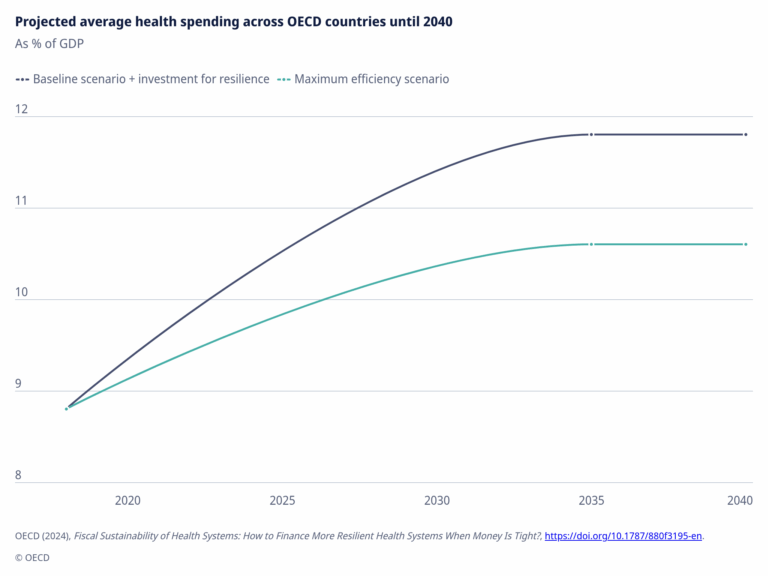
Healthcare has long been cautious toward private equity. While capital has driven modernization and efficiency, many still fear that financial priorities could outweigh patient outcomes. At Tideshift, we’ve seen the need for balance in the sector, one rooted in empathy, accountability, and operational discipline.
Four Structural Shifts Shaping the Future of Care
- Intelligence Across the Value Chain
AI and analytics are now embedded across every operational layer, from diagnostics and scheduling to logistics and supply chains. This layer of intelligence enhances forecasting, efficiency, and care quality. As U.S. healthcare spending nears 20% of GDP, the ability to drive efficiency through data-driven operations has become a strategic imperative, not a technical one.
- Convergence of Technology and Services
Health systems are integrating digital tools across billing, care coordination, and engagement. This convergence blurs the line between tech and traditional care, creating hybrid models that unite data precision with human expertise.
- Modern Manufacturing and Supply Resilience
Medical device and pharmaceutical manufacturers are adopting robotics, additive manufacturing, and digital twins to improve traceability and reduce costs. Nearshoring and localized production are gaining traction, not only to mitigate geopolitical risk but to accelerate turnaround times and enable custom production closer to the point of care.
- Cost Compression and Value-Based Efficiency
Rising labor, material, and regulatory costs are forcing a redesign of how care is financed and delivered. Providers are turning to shared service models, centralized data platforms, and AI-driven procurement to control expenses. Value-based care incentives now reward efficiency and measurable outcomes, pushing stakeholders to reengineer structures that once prioritized volume over value.
Looking Ahead
Healthcare is moving from fragmented silos to an integrated system of systems, intelligent, distributed, and data-driven. Progress at this scale demands balance: innovation with reliability, automation with trust, and modernization with accountability.
For investors and operators alike, value will accrue to those who can translate complexity into scalability, connecting data, infrastructure, and people in ways that deliver measurable impact. The systems being built today will define not only how care is delivered, but how it is governed, protected, and sustained.
About Tideshift
Headquartered in Boston, Tideshift Capital Group is a private investment firm focused on acquiring and scaling lower middle-market businesses across software, services, and industrials. The firm targets attractive opportunities in North America through buyouts, carve-outs, and majority equity positions in companies in transition.
By blending decades of investment and operational experience, Tideshift is shifting investment dynamics to drive superior returns. Our approach is grounded in product-led growth, embedded data and AI capabilities, and the expertise of our in-house Alpha team to create impact velocity.
Learn more at tideshift.com and on LinkedIn
